Building a distributed engineering team is one of the most impactful strategies for technology companies in Singapore, and across the APAC. You gain access to global talent, reduce costs, and increase flexibility. However, for a distributed team to work long-term, you need thoughtful approaches to team structure, communication, culture, and tooling. This guide shows you the way.
1. Choosing the Right Team Structure
Before you start hiring, you need to define the right team structure for your distributed engineering team. There are several models, each with its own advantages and disadvantages:
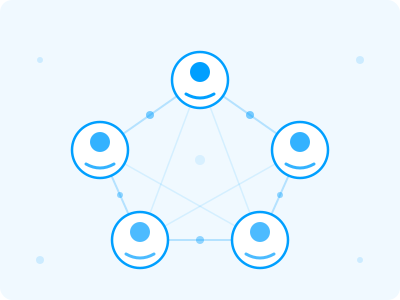
- Fully Distributed Team: All team members work remotely with no central office. This model offers maximum flexibility and the broadest access to the global talent pool. However, it requires the strongest discipline in communication and processes. Many successful companies have proven that this model works even with large teams.
- Hub-and-Spoke Model: There are one or more central offices (hubs), supplemented by remote team members (spokes). This model is suitable for companies that already have an existing on-site team and want to gradually expand into remote work.
- Time-Zone-Based Teams: Teams are organized by time zones to enable synchronous collaboration. Each team covers a specific time zone and has clear handover points with other teams. This theoretically enables 24-hour development.
- Function-Based Teams: Teams are organized by function (e.g., frontend, backend, DevOps, QA), with each team potentially having members from different locations. This model is suitable for companies with clear technical domains.
Choosing the right structure depends on the size of your team, the complexity of your product, existing processes, and your company culture. In practice, many companies use a combination of these models. For Singapore-based companies hiring globally, a hub-and-spoke model with Singapore or Marina Bay as the hub is often a strong starting point.
2. Hiring and Onboarding for Distributed Teams
The hiring process for a distributed team differs from traditional recruitment in several important ways. In addition to technical qualifications, you need to specifically assess remote-specific skills.
- Assess Remote Experience: Candidates with proven remote experience are typically productive faster. Ask for specific examples of collaboration in distributed teams and the tools they used.
- Test Written Communication: In remote teams, written communication is at least as important as verbal. Pay attention to the quality of the candidate's emails and messages throughout the application process.
- Ensure Cultural Fit: Diversity is a strength of distributed teams, but shared values and work principles are indispensable. In Singapore, where teams often include professionals from India, Pakistan, Europe, and the Arab world, cultural alignment matters as much as technical ability. Ensure new team members understand and embrace the company culture.
- Structured Onboarding: Remote onboarding must be carefully planned. Create a detailed onboarding plan with clear milestones for the first 30, 60, and 90 days. Assign each new hire a buddy who serves as their first point of contact.
A common mistake is rushing through onboarding. Give new team members at least two weeks to familiarize themselves with the codebase, processes, and team before expecting productive contributions.
3. Optimizing Communication and Collaboration
Communication is the heart of a successful distributed team. Finding the right balance between synchronous and asynchronous communication is one of the biggest challenges.
- Asynchronous as Default: Make asynchronous communication the norm and synchronous meetings the exception. Document decisions in writing, use detailed pull request descriptions, and record important discussions in a wiki or Confluence.
- Define Overlapping Working Hours: Establish a core time window when all team members should be available. Two to four overlapping hours per day are usually sufficient for synchronous coordination. For teams spanning Singapore (SGT/UTC+8) and other regions, plan these windows carefully.
- Establish Regular Rituals: Weekly team calls, monthly retrospectives, and quarterly planning sessions give the team structure and cohesion. Keep these appointments sacred and only cancel them in exceptional cases.
- Make Documentation a Priority: In distributed teams, documentation is not a luxury but a necessity. ADRs (Architecture Decision Records), technical specifications, runbooks, and API documentation must be up-to-date and accessible.
A proven principle: if information is relevant to more than one person, it should be documented. This documentation culture pays off in the long run, especially when new team members join.
4. The Right Tools and Infrastructure
A distributed engineering team needs the right tools for seamless collaboration. Here are the most important categories at a glance:
- Version Control and Code Collaboration: GitHub or GitLab form the foundation. Use pull requests with clear review guidelines, branch protection rules, and automated CI/CD pipelines.
- Communication: Slack or Microsoft Teams for daily communication, Zoom or Google Meet for video calls. Structure channels by topic and avoid channel overload.
- Project Management: Jira, Linear, or Notion for task management. Choose a tool that provides transparency on progress without becoming bureaucratic.
- Documentation: Confluence, Notion, or a Git-based wiki for technical documentation. The key is that a single system serves as the "source of truth."
- Security: VPN, password managers (1Password, Bitwarden), two-factor authentication, and a clear policy framework for handling sensitive data are essential.
5. Strengthening Team Culture and Cohesion
A strong team culture does not emerge on its own, especially not in distributed teams. It must be actively shaped and nurtured. Here are proven strategies:
- Define Shared Values: Work with the team to develop core values that guide collaboration. Examples: transparency, ownership, willingness to learn, respectful interaction.
- Encourage Informal Interaction: Set up Slack channels for topics outside of work (hobbies, cooking, sports). Virtual coffee breaks and game nights may sound trivial, but they are the glue that holds remote teams together.
- Plan In-Person Meetups: If the budget allows, schedule one to two offsites per year. Singapore is a popular choice for team offsites thanks to its world-class infrastructure, easy visa policies, and central location between Europe and Asia. These gatherings strengthen relationships in ways that no video call can replace.
- Make Successes Visible: Recognize achievements publicly and share positive customer feedback with the entire team. In remote settings, wins can quickly go unnoticed.
6. Scaling and Long-Term Success
Scaling a distributed engineering team brings new challenges. What works with five developers may need to be rethought at 20 or 50 developers.
- Document and Standardize Processes: Undocumented processes quickly become bottlenecks as teams grow. Playbooks for deployment, incident response, code review, and onboarding help address this.
- Hire Engineering Managers: Starting at 6-8 developers, you need someone dedicated to people development, process optimization, and team dynamics.
- Establish Technical Standards: Style guides, Architecture Decision Records, and shared libraries keep code consistent. Automated linting and formatting tools enforce these standards in daily work.
- Reflect Regularly: Monthly retrospectives help identify problems early. Listen to your team and adapt processes when they are no longer working.
- Enable Continued Learning: Budgets for conferences (Singapore Tech Week, SFF Fintech Festival), online courses, and certifications. Internal tech talks and hackathons further promote knowledge sharing. Singapore's Tech.Pass and Employment Pass programs for skilled professionals can also help retain top engineering talent long-term.
Building a distributed engineering team is not a one-time project. It requires constant learning, adapting, and investing. In return, you get a strong, satisfied team with access to top talent worldwide.
Tools for Building Your Team
Plan your distributed team with our free tools:
- Team Cost Calculator - Calculate team costs for different locations
- Salary Calculator - Compare market-rate salaries worldwide